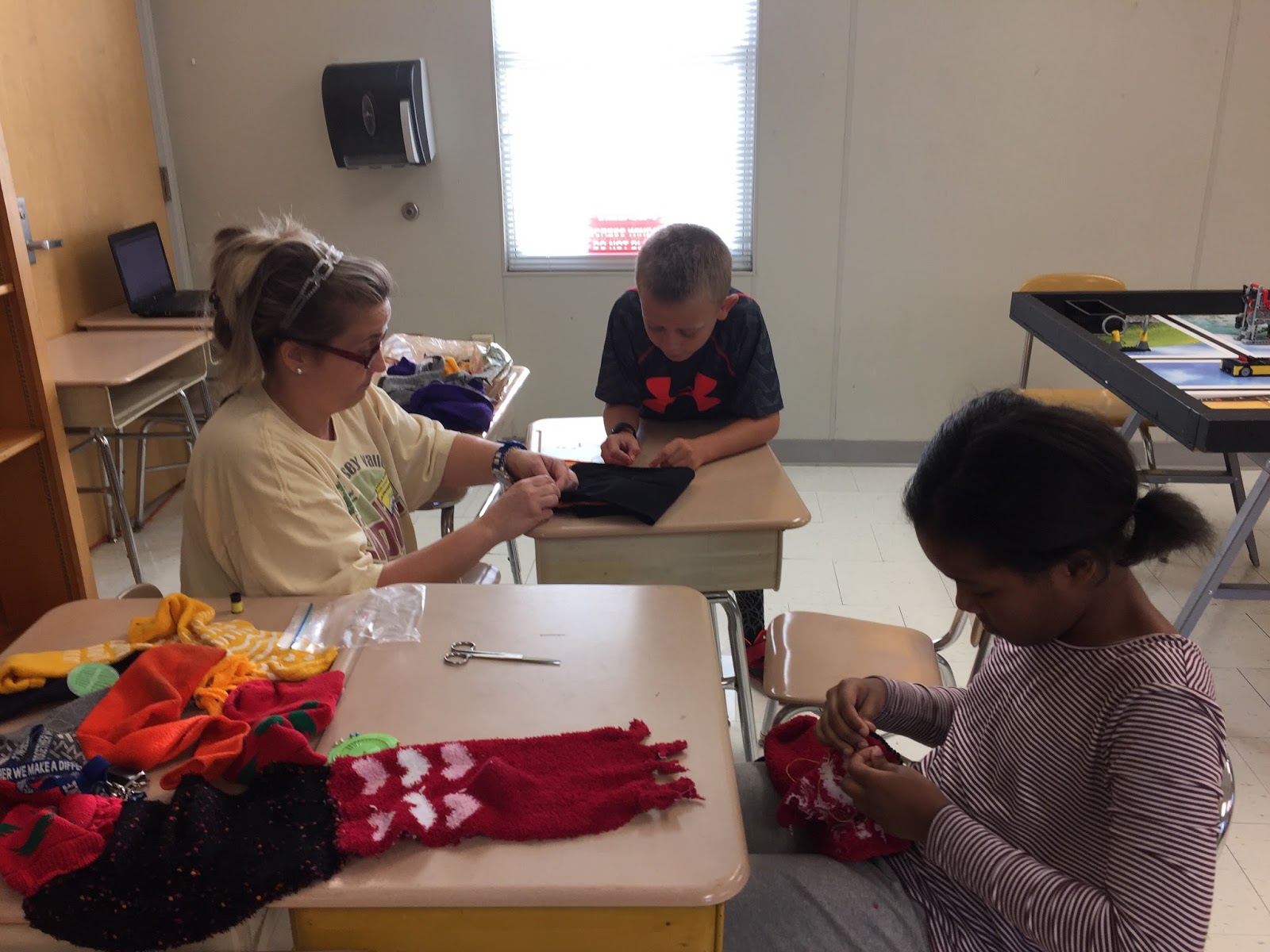
The team is well on it's way to recycling mismatched socks and learning how to make them into scarves for the homeless. Camden create this fantastic sign for our donation bin.
I love the proud faces here from a job well done!
While some of the team was working on learning how to sew, the rest of us were working on the mission run programming. I think we have a headache:-) Certainly, the kids have a good idea of how hard it is to make the robot do many successive tasks. They aso are beginning to understand how one tiny change can have a ripple effect on robot behavior causing a lot of readjustment with the code.
Our FIRST Lego League team took a tour of the South Wake Landfill. I wanted to share some facts we learned on the tour along with some pictures. Facts
The South Wake Landfill is about 700 acres big.
There are 11 convenience centers (offsite locations where citizens can dump trash) in Wake County. We have one of these near our school on Old Stage Road.
The recycling center takes large items (e.g., appliances, large plastic toys) along with hazardous items like batteries, engine oil, and paint plus cooking oil.
Global Electronic Processing in Durham handles the recycling of electronics.
90% of the items collected are recycled.
There are many items that could be recycled that end up in the landfill instead.
The recycling center is open Monday - Saturday 8AM-4PM.
The South Wake Landfill is made up of an older landfill site that was opened in the late 70s and a new landfill site opened in 2008.
The current landfill is designed to last 25 years but may last as long as 35-40 years.
The new landfill is composed of 5 cells. Cell 1 just closed. They are putting garbage in cell 2 now.
By law, water around a landfill must be monitored for 30 years after it closes (plus while it is open). Water is still be monitored in the old landfill site.
150 garbage trucks bring trash to the landfill each day.
That amounts to 16000 tons of garbage a day.
Trucks pay $32 per ton.
Some garbage is brought in from transfer stations around the county. Those tractor trailers have a walking floor to empty garbage in under 40 minutes.
Gulls (birds) from the Great Lakes migrate here in the winter.
Eagles feast on the gulls.
The Audobon Society comes on site for the Great Backyard Bird Count each year to count the number and types of birds at the landfill.
The trash is covered at night by a tarp-like plastic and a poly shell clay spray. This keeps trash from flying out of the site and from animals dragging it off.
Terex 8240 bulldozers are used to push the trash around.
All landfills have garbage liquid. The leached juices are collected and recycled at the water plant.
The landfill also makes power to return to the grid from methane gas. This power can provide electricity for up to 12000 homes in winter and 5000 homes in the summer.
24 refurbished diesel engines for tractor trailers were modified to run on methane and hooked up to generators/turbines to generate the power.
Garbage trucks must be washed before leaving landfill on rainy days.
Trucks are weighed on the way in and out and the values are subtracted to determine the amount of trash dumped.
We had an awesome tour guide. She was very informative. We also had a very enjoyable tour. We traveled the site in a small tour bus with air conditioning and filtration. We were comfortable and never smelled a thing! I would certainly recommend the tour to others.
The main message I took away is that we are equipped to recycle just about everything, but people are still putting items into the trash that they shouldn't.
Ready to take the tour!
Getting on the tour bus with our goody bag. Everything, including the bag itself, was made from recycled items.
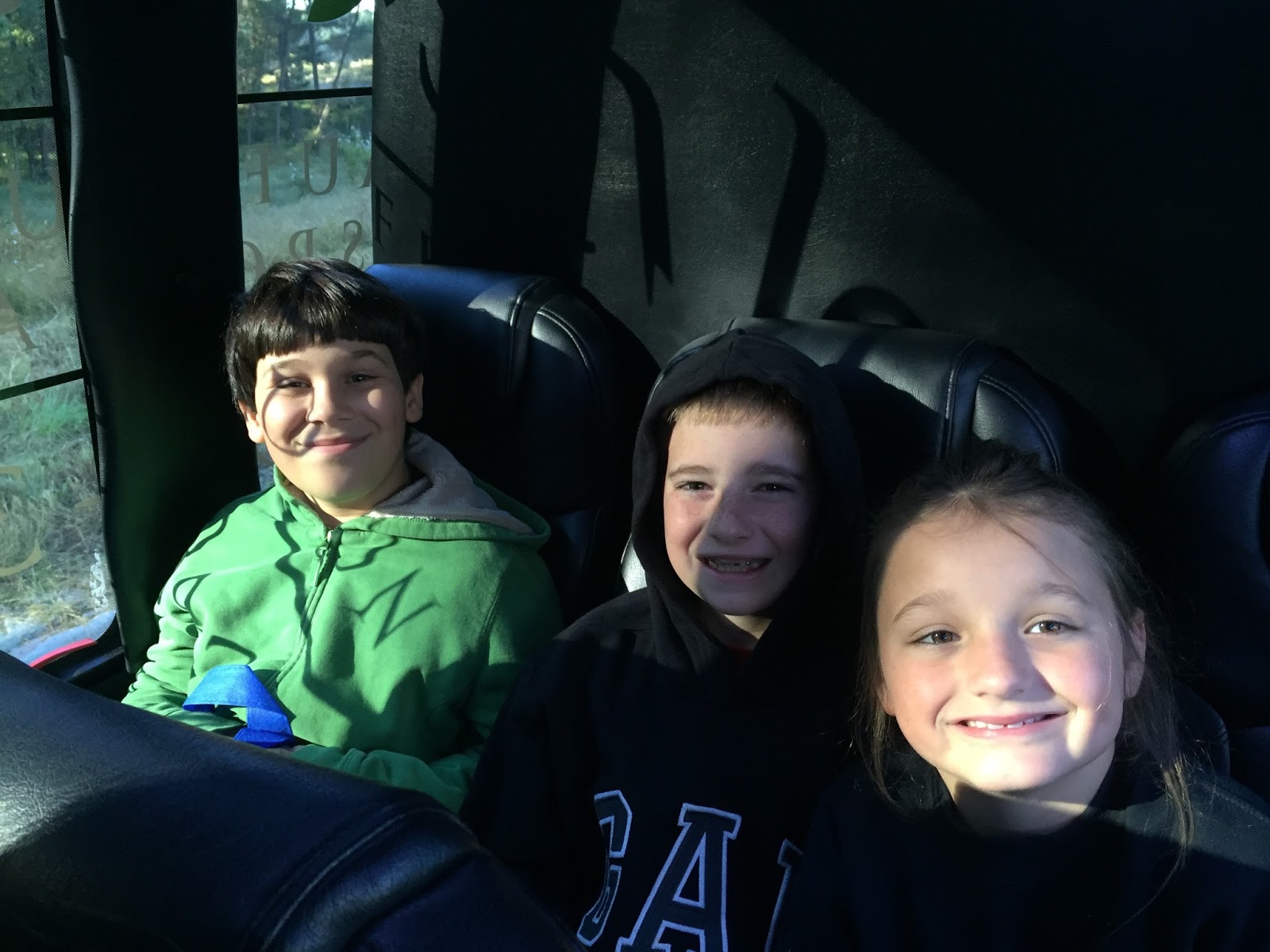
Nice and comfy on the tour bus.
The bag is made from recycled plastic bottles.
A general map of the areas that we toured.
Electronics ready for recycling. The landfill is overrun with old CRT screens.
Batteries, oil, and paint are collected here.
They take old propane tanks.
They take car, rechargeable, and household batteries.
This is the oyster shell recycling area. They truck these back to the beach so baby oysters can attach to them.
This is the old landfill mound. Pipes release gas.
These tubes direct rain water runoff down to the ditch.
Part of the lining of the new landfill site.
Also part of the lining.
The 3rd and final layer of the lining.
We go out briefly on top of the old landfill site. It's a great view including Shearon Harris.
Cell one covered and cell 2 being filled.
Excess methane gas is burned off here when necessary.
Leached landfill juice is stored here before going to the water recycling center.
I'll be showing this video at our team meeting today. Wow! As a mostly rookie team, this is above our skill level, but it's still cool to watch and inspiring.
The team worked together to program the robot to run multiple missions. The kids combined the programs that they had written previously to solve and run individual missions. In order to do this, they had to discuss the right order to run the missions in. They were working on number 3 when we ran out of time.
The team also discussed the project. Beth reported that her research into electronic recycling shows that there really aren't any components that aren't already recycled. Recycling of clothing has come up several times before. Ms. Norwood and Beth went to two area thrift stores and talked to the staff about what they do with unusable clothing donations. For example, what happens to socks that don't have a mates (mismatched or stray socks). It turns out that they are thrown away. The team did some brainstorming on ideas to reuse mismatched socks. There are lots of craft ideas and cleaning uses on Pinterest. But, what else? The kids came up with a super idea which I will avoid printing on this blog for now.
Homework
More brainstorming was done, and some of the kids signed up to work on the project before we meet again on Thursday.
Camden - Create sock collection bin for school office area
Johnny and Gavin - Create flyer for Tuesday folders
Zoe, Joshua, Beth - Create posters for school hallways/classrooms
Ms. Norwood will send an e-mail with additional explanation.
What's Next
The kids will continue working on the robot run program.
The tray to collect the compost puck is interfering with the turtle pull. Rework.
The program to pull the turtle needs adjustment.
Starting from the corner is not proving very accurate.
Mount crane bricks permanently.
The kids will show their completed project assignments and sign up for next steps.
Outline
We worked to finish up the work we were doing on the Demolition mission. The kids have a box to catch the robot and a method to push the building over. They need to join the programs and work them into other missions we are doing on the board. Demolition with valuables back to safety and no black bars stranded is worth 145 pts:-) I think 400 is the new 100 for points scoring this year. That is, we may get 400 points this year, but I think that will be equivalent to the 100 we scored last year.
The team had a pow wow about what missions to tackle next.
The kids got busy grabbing the hook near the turtle and have a plan for how to move the turtle back into its circle. Other team members are working for a method to drop the people near the sorter and the octopus and chicken into circles.
What's Next
Complete programming to move the turtle into the circle.
Figure out how to deposit animals and do programming.
We watched a Trash Trek YouTube video that showed one method to solve several of the missions. Everyone, please watch! While it is not our intent to copy these solutions, we should certainly study them and see if we can incorporate anything helpful.
Our school custodian, Mr. Z, came to talk to us about trash and recycling at our school. It was a very fun an informative interview.
We learned many interesting facts.
Mr. Z works 5:00AM - 2:30PM every day, and other members of the custodial staff work late afternoon into the evening.
Our school recycles MANY items like paper, bottles, electronics, cardboard, and book.
Mr. Z expressed an interest in recycling food.
We talked about batteries. The school does not use many, but they are in the large classroom clocks.
The school recyclables are sorted and separated.
Trash is picked up twice a week, but additional pick-ups can be requested.
Recyclables are picked up once a week.
There are special procedures county-wide for various waste items such as using bio hazard stickers on anything that has blood on it.
Mr. Z has not heard about the school initiative for a Wonder Space. Shouldn't some school recyclables be headed to that room?
Only paper should go in the green recycle bins in each classroom. There are white collection containers on each hallway for other recyclables. Students collect the paper once a week.
We also worked on solving missions primarily the building with brackets mission model/destruction. Homework
None between now and Thursday.
What's Next
There was some interest in improving battery recycling as our project. This would relate to school and home. Most of the team didn't think their parents recycled batteries. How many toys have double A, triple A, C or D batteries? How often do they run down? How often are they thrown away?
It is not desirable for the kids to handle old batteries, but they agreed that they could teach their parents about recycling batteries in our county (Holly Springs) and make collection tins for school and home. I found a couple of recycling storage containers online on Pinterest. What else could we recycle to create a battery recycle container?